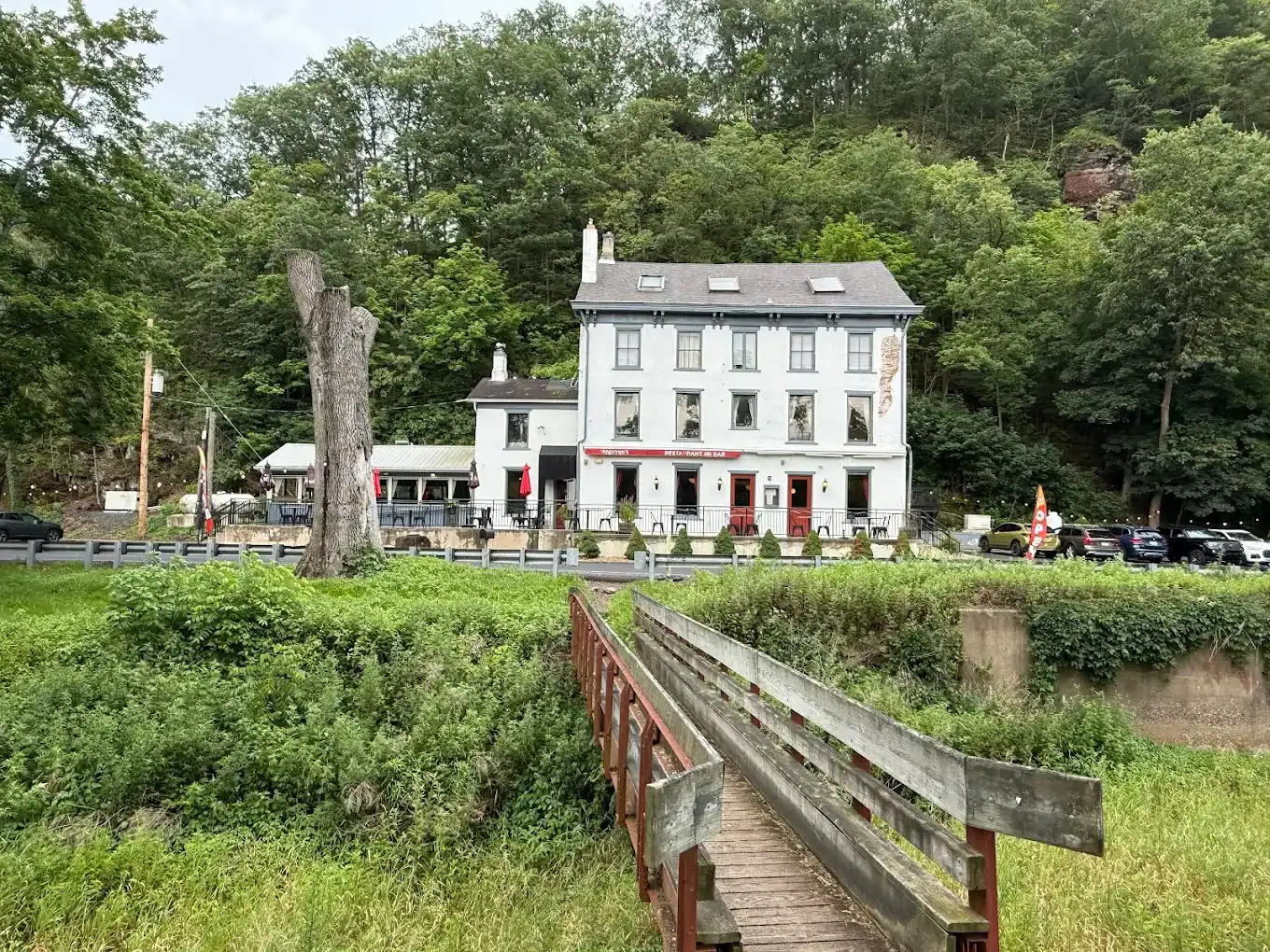
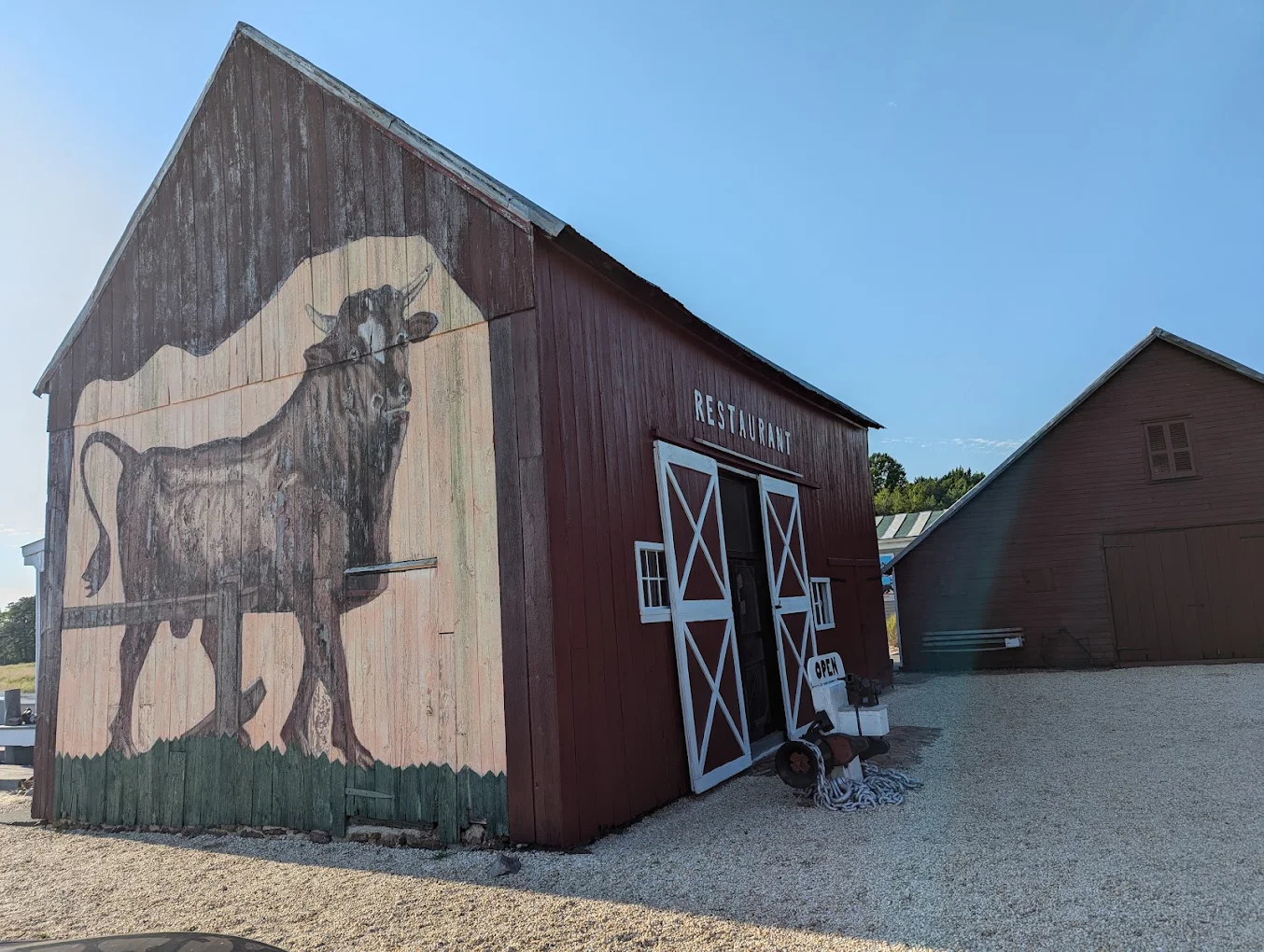
This will be a rural, scenic ride of about 75 miles to The Narrows Restaurant for lunch in Upper Eddy, PA. The Muster point is the QuickChek, 361 Union Ave (Rt 28) Bridgewater, NJ, with KSU at 1000 SHARP!! If you plan to ride, please RSVP with Jeff @ 732.371.2902 or Keith @ 914.772.2350. Please arrive at the QuickChek by 0945, with a full tank of fuel and an empty bladder!
.
.
.
.
.
.
.
.
.
.
.
.
.
.
.
.
.
.
.
THE STORY OF BLACK EDDY ON THE DELAWARE RIVER
A pioneering family, whirlpools, loggers on timber rafts, Bruce Springsteen Band and more
By Carl LaVO – Bucks County Herald
Thursday, July 9, 2026
I’ve always been wary of river eddies. They’re whirlpools. If they’re strong enough and deep enough, they can pull you under and hold you there. I know. It happened to me and my high school buddy Bill going over a cascade on the wild Crystal Stanislaus River in the Sierra Mountains when we were in our 20s.
The power of the stream flipped our Klepper folding kayak, tossing us free. In the plunge, I was sucked under by a whirlpool near the base of the falls. It took me the greatest effort to break free, bob to the surface, find Bill, bail the kayak and keep going downriver.
Years later, I arrived in Bucks County and learned from an old map there was a “black eddy” opposite Milford, N.J. on the Delaware River. “Black” as in deep and powerful? In fact, there were two vortexes. An upper one and a lower one. Wow! I had to take a look. It was quite a surprise to find the river rather shallow and quite placid where I expected to find whirlpools.
So, what’s behind the name? The answer traces back to 18th century loggers who floated timber for sailing ships down the river to Philadelphia. They did so by lashing logs together to form enormous rafts. Occasionally large rocks, other obstructions or a sharp bend in the stream caused the river to back flow, creating a swirl called an eddy. If the swirls were large enough, they created calm harbors, places where river rafters could pull in for a respite.
The Black family established a settlement at the upper eddy opposite Milford. People began referring to it as Black Eddy after the family. A few miles downstream another eddy at the confluence of Tohickon Creek and the river was also called Black Eddy. Eventually the two became Upper Black Eddy and Lower Black Eddy. The village around the lower eddy went a step further by choosing a new name: Point Pleasant.
The opening of the Delaware Canal in 1832 brought prosperity to Upper Black Eddy. The 60-mile-long commercial waterway paralleling the river passed through town and linked Easton with the river estuary at Bristol.
By the mid-1800s, Upper Black Eddy bustled with 40 houses, three hotels, a wide variety of shops, a canal boat building yard and stables for mules that pulled the boats loaded with upstate coal to fuel factories in the lower estuary. In summertime the village became a resort for well-to-do visitors from Philadelphia 60 miles to the south and New York 70 miles to the north. A covered bridge that opened in 1841 linked Milford to Upper Black Eddy. People began referring to the village as “Bridgeton” with the creation of a new township inspired by Upper Black Eddy citizens.
Carved out of much larger Nockamixon Township, Bridgeton is Bucks’ smallest township at just 6.7 square miles. It contains some of the county’s most unique natural features which my family and I have enjoyed for years.
Among them is Ringing Rocks, a prehistoric field of volcanized boulders, tossed together in an open field and capable of creating musical notes when struck with a hammer. In the late 1800s, the maestro of a New Jersey orchestra put on a performance by arranging select stones and playing them like a Mother Nature xylophone.
Down a side trail from Ringing Rocks is High Falls which produces a spectacular cascade in the early spring and after heavy summer downpours. Other noteworthy features in Bridgeton are Falls Creek Ravine, Wild Cat Hollow and Mine Spring. In Point Pleasant (the former Lower Black Eddy) Bucks County River Country helps define the town and offers tubing, kayaking, canoe and raft rentals.
Lately in Upper Black Eddy, a new 107-acre protected sanctuary and two-mile, looping foot trail have opened. The Bridgeton Nature Preserve is a joint project of the township supervisors, the Tinicum Conservancy and the Appalachian Mountain Club. It has transformed a long-abandoned sand and gravel quarry into a lush natural habitat featuring scenic ponds, freshwater springs and wetlands below a canopy of tall trees. Ultimately, the plan is to connect the preserve’s walking trail to the Highlands Trail network at Ringing Rocks County Park.
While researching Upper Black Eddy’s history, I found a link to Rock ‘n’ Roll music that should thrill glockenspiel lovers. Danny Federici, a member of Bruce Springsteen’s E Street Band, lived in Upper Black Eddy prior to his death in 2008. He played the organ, accordion and glockenspiel and performed on 10 of Springsteen’s albums.
Sources include “Place Names in Bucks County” by George MacReynolds (1942), and “Abandoned quarry to community sanctuary: Bridgeton Nature Preserve opens” by Andy Holtzman, Bucks County Herald (June 9, 2026). Carl LaVO can be reached at ca*******@***il.com.